In the past three weeks our Dallas/Fort Worth community has been rocked by a trilogy of murder, deviant parenting and the loss of a promising young life.
First we watched in agony as a young mother egged her middle-school age daughter into fisticuffs with another young lady; we reacted in horror at the news that a nineteen-year old young man had been pushed to his death in front of a train because he refused to give up his Ipod; and we were shocked at yet another incident of domestic violence when a young man, apparently distraught regarding the end of his relationship, gunned down his children’s mother, her stepfather and her younger sister’s boyfriend.
It is tempting to wag our heads in disbelief and dismiss the above incidents as common occurrence. Then we don’t have to accept our responsibility.
We must, however, view what happened with a different set of cultural lens. Then we’d see the nexus of parenting, relationships and the perplexing issues touching our youth. We’d see the three incidents not as isolated events, but rather as a continuum of the decline in values that has rocked our country and, by default, our community.
The common ingredient in all three scenarios is violence. We live in a violent culture; our relationships are touched with conflict. The messages we get on an almost daily basis is use force to get what you want. Hence, a mother teaches her young daughter to use her fists; a group of young men use group intimidation; a man employs a bullet.
What’s happened to us? How did we fall so low? And, most crucially, who is responsible?
It’s easy to point out fingers in all three incidents. But here’s the greater point: in a very real sense, all of us – by default – is responsible. We all share in the plot and execution of every conceivable incident of crime in our community when precious lives are taken and even more precious lives are left in tatters.
I am responsible when I don’t use my God-given voice to speak to a person reeking with self-destructive behaviors. Each of the offending parties comes from a family unit. Somebody had to catch wind of a young mother’s angry spirit; somebody had to witness the slow descent of one of those young men into the abyss of negative peer pressure; surely someone had to glimpse the despair of a young man who didn’t quite know how to handle the end of a relationship. And maybe someone did try to intervene at some point, at some time. But was it enough? Could more have been done?
But maybe it’s you reading this piece that may need the most attention. I have been for the last year embroiled in a bitter child visitation and access war with the mother of my youngest son. Words have been exchanged; no doubt insults hurled. But at the forefront of my mind I keep this one positive truth: it doesn’t have to be this way. And that leads me to find other, more diplomatic routes to intervention. But we can commit to doing better, to take a more active role in the lives of those whom we know to be spiraling out of control. We may or may not change outcomes, but in the end what counts is having tried. In trying, we at least prevent the ruined lives left in the wake of tragedy.

Wednesday, November 30, 2011

Wednesday, June 1, 2011

No Glory Without a Story: How to Move Past the Hurt, Guilt and Mistakes of Your Past
A critically-acclaimed anthology of writers who share the power of the pen to relate how they overcame some incredible odds to claim their God-given, brand-new future! Whatever challenge you are going through, you will be inspired by these valiant men and women of God who's only reason for participating in this project is to empower the reader!
I am honored to have been asked to participate in this life-changing literary project!
No Glory Without a Story! Real stories. Real struggles. Real victories!
Empowered reading!
W. Eric Croomes
Available soon on Amazon, Barnes and Noble.com! For ordering information call 214.493.2875 or 817.504.7257
And join me for the launch of my Conversations on Being Black and Male in America book tour Saturday, June 18, 2011 from 2p to 4p at the Dock Book Store in Fort Worth, Texas 6637 Meadowbrook Driv 817.457.5700
Tuesday, May 31, 2011
W. Eric Croomes presents: No Glory Without a Story!
W. Eric Croomes Presents
Hello my friend! I am excited to announce the publication of the critically-acclaimed book, No Story Without a Story, How to Move Forward in Victory after the Hurt, Guilt and Mistakes of Your Past, to be released June 10, 2011 (M&M Consulting)! This is a book that is edited by Dr. Mia Y. Merritt and compiled by twenty authors whose sole mission is to help readers move through some of life's toughest challenges we as authors have been through!
No Glory Without a Story is an anthology of writers who intimately share how we overcame some very difficult times in our personal lives - broken relationships, parenting issues, financial challenges, depression, infidelity to name a few - how our testimony was shaped and how that testimony can help empower you!
In my chapter - Their Eyes Were Watching Daddy - I write about fatherhood: my story, my lessons and my advice to men who are seeking to remain relevant in the lives of their offspring. As the father of two sons born during two very different periods of my life, I am seeking to be the best father I can be and I want fathers who are struggling with their role to know they have a kindred soul!
No Glory Without A Story is the culmination of a dream of our editor, Dr. Mia Y. Merritt, who desired to compile a literary medium of authors who would directly share their own life stories toward the purpose of empowering those who are going through tough times. I have posted her information below to let you discover more about this incredible woman of God who is changing the world!
I am inviting you to join me on June 18, 2011 from 2pm to 4pm at the Dock Bookstore in Fort Worth, Texas, as I begin a substantive conversation regarding the general issues in No Glory Without a Story and the specific challenges of being black and male in America in relation to fatherhood, relationships and the economy. More information to follow!
No Glory Without a Story! Real stories. Real struggles. Real victories!
Empowered reading!
W. Eric Croomes, contributing author
W. Eric Croomes is an author, motivational speaker and editor of TheVillageReport.Net, a monthly blog-mag dedicated to the educational, economic, social and spiritual empowerment of the African American community. He is host of The Village Report with W. Eric Croomes, a weekly issues and answers talk-show that airs on BlogTalkRadio.com.
Eric is a graduate of Jarvis Christian College in Hawkins, Texas, and is founder and executive director of Their Eyes Were Watching Daddy, a non-profit support group for unmarried and divorced fathers.
In 2002, Eric self-published Dance in the Dark, Poetic Reflections on Love and Culture, a collection of his original poems and essays.
Brotha2Brotha, Becoming Healthy Men from the Inside Out, a spiritual primer for black men is Eric's second self-published book and was released in September, 2006.
Learn more about editor and publisher Dr. Mia Y. Merritt at:
www.miamerritt.com
Contact information for W. Eric Croomes:
W. Eric Croomes
Cell: 214.493.2875
wericcroomes@yahoo.com
Like us on Facebook at: Their Eyes Were Watching Daddy
Hello my friend! I am excited to announce the publication of the critically-acclaimed book, No Story Without a Story, How to Move Forward in Victory after the Hurt, Guilt and Mistakes of Your Past, to be released June 10, 2011 (M&M Consulting)! This is a book that is edited by Dr. Mia Y. Merritt and compiled by twenty authors whose sole mission is to help readers move through some of life's toughest challenges we as authors have been through!
No Glory Without a Story is an anthology of writers who intimately share how we overcame some very difficult times in our personal lives - broken relationships, parenting issues, financial challenges, depression, infidelity to name a few - how our testimony was shaped and how that testimony can help empower you!
In my chapter - Their Eyes Were Watching Daddy - I write about fatherhood: my story, my lessons and my advice to men who are seeking to remain relevant in the lives of their offspring. As the father of two sons born during two very different periods of my life, I am seeking to be the best father I can be and I want fathers who are struggling with their role to know they have a kindred soul!
No Glory Without A Story is the culmination of a dream of our editor, Dr. Mia Y. Merritt, who desired to compile a literary medium of authors who would directly share their own life stories toward the purpose of empowering those who are going through tough times. I have posted her information below to let you discover more about this incredible woman of God who is changing the world!
I am inviting you to join me on June 18, 2011 from 2pm to 4pm at the Dock Bookstore in Fort Worth, Texas, as I begin a substantive conversation regarding the general issues in No Glory Without a Story and the specific challenges of being black and male in America in relation to fatherhood, relationships and the economy. More information to follow!
No Glory Without a Story! Real stories. Real struggles. Real victories!
Empowered reading!
W. Eric Croomes, contributing author
W. Eric Croomes is an author, motivational speaker and editor of TheVillageReport.Net, a monthly blog-mag dedicated to the educational, economic, social and spiritual empowerment of the African American community. He is host of The Village Report with W. Eric Croomes, a weekly issues and answers talk-show that airs on BlogTalkRadio.com.
Eric is a graduate of Jarvis Christian College in Hawkins, Texas, and is founder and executive director of Their Eyes Were Watching Daddy, a non-profit support group for unmarried and divorced fathers.
In 2002, Eric self-published Dance in the Dark, Poetic Reflections on Love and Culture, a collection of his original poems and essays.
Brotha2Brotha, Becoming Healthy Men from the Inside Out, a spiritual primer for black men is Eric's second self-published book and was released in September, 2006.
Learn more about editor and publisher Dr. Mia Y. Merritt at:
www.miamerritt.com
Contact information for W. Eric Croomes:
W. Eric Croomes
Cell: 214.493.2875
wericcroomes@yahoo.com
Like us on Facebook at: Their Eyes Were Watching Daddy
Monday, May 30, 2011
I'm A Changed Man!
Changed men make for changed lives, changed families, changed communities. But where does that type of profound change come from? How does a man change from being negative to positive, from being weak and docile to strong and courageous, from engaging in self-destructive behavior to harnessing his authentic power as a valiant man of God?
As we witness St. Paul on a dusty Damascus road, we see that true and lasting change comes as a result of a direct confrontation with God; it is, therefore, profoundly spiritual. What we need, then, are men who have been changed spiritually, for spiritual formation is the foundation to an empowered life, as evidenced by a transformation of his intent and perspective.
The Acts record Saul, before his transformation to Paul, as suffering from evil intent, as he sought to “ravage the church.” His intent was wrong-headed, malicious and mean-spirited; he only wanted to see the church suffer. Saul sought the persecution of the early church. But look what happens; Saul runs into God on a bustling road to Damascus through a blinding light, which knocks him off his horse. God, though, does not touch Saul’s intentions, but works on his perspective, instructing Saul to “get up, and enter the city.” Paul ultimately becomes the trailblazer of the early church and history’s most revered son of faith.
Who really can recite the chorus, “I’m a changed man”!? It is the man who, simply, was doing something that was destructive and is now engaging in things that are constructive. If you’ve been abusing substances and you say I’m a changed man, but you are still abusing substances, it would be quite hard to believe you. When a man has truly been changed, his intent and his perspective change, as well.
For, the single lesson we can extract from Paul's unique visitation with God on the Damascus road is that sometimes God does not necessarily change our direction, but rather changes our perspective on the direction we're headed. Saul is instructed to go into the city – the same city where he intended on pillaging the church – but now his perspective is different, he now has a new mission! This change of perspective can only come by spiritual transformation. By spiritual I mean the inward dimension of life that flows from direct communion with God, a communion nurtured by prayer, ritual, meditation and worship. “Life is first an inner experience”, writes author Susan L. Taylor, “all the peace and security we are seeking is within us.”
"I'm a changed man" is a chorus, ringing with jubilance, yet the verses are made up of self-examination, vigorous reflection and the courage to move on in spite of our fear. You see, change may inspire fear in you; it may cause you to walk tepidly among the carnage of your insecurities. A lot of people have experienced failure because they could not handle change.
Changed men are powerful men; changed men are courageous, changed men are leaders. They can move mountains, they can launch global movements, and they can take a stand for righteousness. Changed men are what we need.
As we witness St. Paul on a dusty Damascus road, we see that true and lasting change comes as a result of a direct confrontation with God; it is, therefore, profoundly spiritual. What we need, then, are men who have been changed spiritually, for spiritual formation is the foundation to an empowered life, as evidenced by a transformation of his intent and perspective.
The Acts record Saul, before his transformation to Paul, as suffering from evil intent, as he sought to “ravage the church.” His intent was wrong-headed, malicious and mean-spirited; he only wanted to see the church suffer. Saul sought the persecution of the early church. But look what happens; Saul runs into God on a bustling road to Damascus through a blinding light, which knocks him off his horse. God, though, does not touch Saul’s intentions, but works on his perspective, instructing Saul to “get up, and enter the city.” Paul ultimately becomes the trailblazer of the early church and history’s most revered son of faith.
Who really can recite the chorus, “I’m a changed man”!? It is the man who, simply, was doing something that was destructive and is now engaging in things that are constructive. If you’ve been abusing substances and you say I’m a changed man, but you are still abusing substances, it would be quite hard to believe you. When a man has truly been changed, his intent and his perspective change, as well.
For, the single lesson we can extract from Paul's unique visitation with God on the Damascus road is that sometimes God does not necessarily change our direction, but rather changes our perspective on the direction we're headed. Saul is instructed to go into the city – the same city where he intended on pillaging the church – but now his perspective is different, he now has a new mission! This change of perspective can only come by spiritual transformation. By spiritual I mean the inward dimension of life that flows from direct communion with God, a communion nurtured by prayer, ritual, meditation and worship. “Life is first an inner experience”, writes author Susan L. Taylor, “all the peace and security we are seeking is within us.”
"I'm a changed man" is a chorus, ringing with jubilance, yet the verses are made up of self-examination, vigorous reflection and the courage to move on in spite of our fear. You see, change may inspire fear in you; it may cause you to walk tepidly among the carnage of your insecurities. A lot of people have experienced failure because they could not handle change.
Changed men are powerful men; changed men are courageous, changed men are leaders. They can move mountains, they can launch global movements, and they can take a stand for righteousness. Changed men are what we need.
Wednesday, January 21, 2009
TVR Editorial: Where Do We Go From Here?
On Tuesday, January 20, 2009 Barack Hussein Obama, the nation’s first African American president, called the nation to “a new era of responsibility.” It is a noble call to all Americans to help make our country better. Yet it is a call that resonates in the black community like a trumpet. For, now that the pageantry has ended, the revelry has tempered, and the shadow of something the slaves could only dream about has begun to recede, the question is now, where do we go from here? Did we travel to the nation’s capital merely to catch a glimpse of history? Or do we use this majestic occasion to look within ourselves and our communities and find new ways to heed this era of new responsibility? The hard work now begins.
Yet we know for certain that it cannot begin with our fooling ourselves, as may portend a recent CNN poll which found that sixty nine percent of blacks surveyed agreed that the dream of equality has been fulfilled. The presence of a black man as leader of the free world 146 years after the Emancipation Proclamation and 45 years after Dr. King’s dream is no fair arbiter of equality, only a sign that, indeed, progress has been made. And now the dream is put on par with responsibility (indeed Dr. King preached responsibility no less fervently).
Where does this responsibility begin? I say it begins with the person in the mirror. We must recommit ourselves to hard work, hard choices and hard love; finding within ourselves intestinal fortitude to improve our own lives. Each of us has a purpose we’ve been created to strive toward, a greatness – not just fame – that beckons the best within us.
We must, as well, find it within ourselves to take a stand against that which has undermined our self-love and self-esteem for so long now. We must demand of men, myself included, a commitment to the welfare of our families; we must take a stand against the tyranny of ignorance that divides our communities – from the misogynistic lyrics of pop stars to the lunacy of “bagging” among our young black men.
When we muster the best of ourselves and our community, when we become concerned about the issues that beset us, our acceptance of this “era of responsibility” has truly begun.
Yet we know for certain that it cannot begin with our fooling ourselves, as may portend a recent CNN poll which found that sixty nine percent of blacks surveyed agreed that the dream of equality has been fulfilled. The presence of a black man as leader of the free world 146 years after the Emancipation Proclamation and 45 years after Dr. King’s dream is no fair arbiter of equality, only a sign that, indeed, progress has been made. And now the dream is put on par with responsibility (indeed Dr. King preached responsibility no less fervently).
Where does this responsibility begin? I say it begins with the person in the mirror. We must recommit ourselves to hard work, hard choices and hard love; finding within ourselves intestinal fortitude to improve our own lives. Each of us has a purpose we’ve been created to strive toward, a greatness – not just fame – that beckons the best within us.
We must, as well, find it within ourselves to take a stand against that which has undermined our self-love and self-esteem for so long now. We must demand of men, myself included, a commitment to the welfare of our families; we must take a stand against the tyranny of ignorance that divides our communities – from the misogynistic lyrics of pop stars to the lunacy of “bagging” among our young black men.
When we muster the best of ourselves and our community, when we become concerned about the issues that beset us, our acceptance of this “era of responsibility” has truly begun.
Thursday, December 11, 2008
The Myth of the Independent Black Woman

We’ve all heard of her; she’s been crooned, immortalized and hyped since the beginning of the 1990’s as the strong, self-sufficient black woman. She’s appeared in film, literature and theater as the saving grace of the black family and the antidote to black male patriarchy. In the process, she’s become the star of African American post-modern folklore; there aren’t too many black families that don’t claim her as one of their own. She is the independent black woman.
But are independent black women really that independent? And, with all due respect to the crooner Neo, how did the independent black woman come about in the first place, if, in fact, we even give preeminence to her existence?
The Disappearing Black Male
To best answer this we’d have to turn to history and look at such factors as the disappearance of black men as viable marriage partners for black women. If black women have theoretically become independent, it stands to reason at some point they were dependent or, at the very least, co-dependent with men. So what happened?
There are several factors, but let’s start with this one: economics and labor (read: jobs). It’s no coincidence that the emergence into popular culture in the 1990’s of the I-don’t-need-a-man movement coincided with the Clinton inspired economic boom, when it was widely reported that black people were faring as well economically as anytime in American history. It’s befitting, then, that we begin our discussion with the economics behind the façade of independence. Today, the unemployment rate for black males is 9.5%, twice the national average for all males across all ethnicities. This upward trend has had a slow, steady march for the past fifty years and is intimately connected to the closing of steel mills, manufacturing and auto plants and other staples of American productivity. The result: black men began to disappear from the labor force.
At about the same time, two other peculiar events began to unfold. As families began to feel the impact of less black males in the workforce, black mothers began to whisper into the precocious ears of black girls: “get you an education and do things for yourself! Don’t wait on no man to do it for you!” Don’t get me wrong; black mothers were not being hateful toward black males (at least, I’m sure, in most cases); on the contrary, they were looking out for the best interests of their daughters. The other significant event was the election of Ronald Reagan as president of the United States and the advent of the war on drugs and the so-called law and order society.
These three historical events – the reduction of black men in the labor market, how little black girls were socialized, and the law and order society (in terms of how it was a precursor to black male incarceration rates) have all conspired to produce a vacuum in the number of black marriageable men and has, in my opinion, contributed to the myth of the independent black woman.
The Real Meaning of Independence
Now, what’s my point? The point is black women today who pride themselves on being independent should realize their status was attained not just through hard work, determination and burning the midnight oil, but also through a confluence of economic, political and cultural events that aided and abetted their success.
I say this because today the term “independent” seems to have been applied to sisters as a badge of self-reliance, a carefully crafted image pushed to extremes, whose only goal is to reinforce a false notion that they are “self-made”, propagating a kind of economic relativism.
As a result, the black marriage market has been thrown into chaos and relationships between the sexes are as strained as ever. Sadly, a lot of brothers regard independent sisters as so way out, so deeply entrenched in fantasy, that they lose even the desire to approach them (usually interpreted as an inability to handle a “strong black woman”). Is this really the point of achieving independence, to be so insulated from reality that even the prospects of living the rest of one’s life alone raises no internal concern?
Besides this, the notion of independence is neither biblically nor culturally meaningful. If most of black life and love is predicated on our religious experience (as most of it is), and if most black women extract a fair amount of comfort from that experience (and they do), then how do we reconcile notions of independence and what it means to be committed to the well-being of the entire village, if not the opposite sex? What about the emotional, spiritual and non-physical intimate needs that was given to a woman by the Creator and was designed to be fulfilled by a man (although we are responsible for its nurturing)? We were not created in a vacuum; didn't God create a man for a woman and a woman for a man?
Black Relationships: A New Paradigm
What we need are strong, positive, mutually beneficial relationships. We should nurture, love and respect one another’s opinions and ideas and together achieve a sense of becoming while working toward a common goal.
For an embodiment of those ideals, we can turn to our first African American president, Barack Obama, and his wife, Michelle. They have both been successful in achieving the American dream. Although I am not privy to the details of their personal interactions, I must only assume that their success story has had, like all relationships, its share of lows, as well as highs. In the end, however, they were able to forge a mutually benefiting union, one that superseded power relations.
But here is the greater point: Obviously Michelle Obama could have built her own castles of success, given her stellar educational accomplishments. But she chose to leave her career and work tirelessly on the career of her husband. Now I am not suggesting that every woman should follow suit; contrary, what I am saying though is that the sister didn’t have a problem with it.
Instead of lauding Michelle Obama as the model of black feminine independence (as a lot of black women are doing), let’s salute her for channeling that independent energy toward pushing her husband upward to the pinnacle of American politics. Because in the end, Michelle needed Barack and Barack needed Michelle! Michelle Obama didn’t subscribe to the lunatic theory that she didn’t need a man!
Black males want to provide for their families, just like males of any other ethnicity. But how to do it in the face of declining wages, a huge gap in earnings compared to white males and the aforementioned historically high unemployment rate is the challenge for black men today. We’ve got to fight back against that by getting more black males into college and/or pursuing a trade or craft that can be used for economic mobility; in short, education is paramount!
These are the challenges we face, but we really face them as a unit. Black women still experience sexism, racism and other forms of exploitation; the wages they earn still lag woefully behind those of white women. The truth is we are all trying to make it happen! In historical terms, our situation is not much different than that of black men and women who came up from slavery.
They faced a hostile society, open hostility, below minimum wage standards, the prospect of a future with no economic fortune at their fingertips (unlike what we have today): can you imagine the likelihood of an independent black woman back then?
Tuesday, December 9, 2008
Things Fall Apart
I had never imagined one day I’d find myself smack in the middle of a domestic dispute with the mother of my youngest son. But here I am, with a relationship turned sour in the rear-view mirror, a precocious young boy seemingly caught in the middle. I’m searching for ways to redirect the constant exchange of insults and innuendos, the defamation being traded between us.
I have always regarded myself as a positive thinking brother; I just didn’t believe in allowing negativity – and negative people! – into my private domain. I’m still scratching my head as to how it happened.
Lately, though, my thoughts have turned outward to the hundreds of thousands, perhaps millions of black fathers across America, missing in the lives of their kids or who at one time may have been involved in promising relationships with the mothers of their children, but through some breakdown in communication, some odious inability to work things out, things, to quote the venerable Achebe, fall apart, the center cannot hold.
So now that I am a member – a card carrying member, apparently – of this club, I speak from where I am.
Brothers, there is only one person caught in the cross-fire of contempt between you and the mother of your child or children: your offspring. Isn’t it funny how two people who claim to be adults can’t call a truce in the interests of those little ones who never asked to be caught up in the riff-raff in the first place?
A part of me hurts. Or maybe all of me hurts, yet is divided into parts. One that pines for my son, his loveable ways, his adoring smile, the other that grieves the death of a relationship, the cessation of love, the end of the affair.
If I sound like I am waxing romantic here, it’s because I am. I cannot see love as anything but a tragic romance, even with its comedic tapestry. But the real tragedy is the stunted emotional crisis forced upon a young child.
Brothers, we cannot allow our crisis to become their crisis and, regrettably, so many of us have elected to fade from the scene rather than deal with the ignominious effects of lost love.
If you are a brother reading this, and love has long since died, know that there is a constant source of love in the eyes of your child or children, who yearn to connect, or reconnect, with you. If that doesn’t happen, a part of you will always be dead, a part of you will haunt that child and that, in spite of your wishes to inflict as much emotional pain onto the mother, will be the greater calamity of their lives – long after you leave the scene.
Fortunately I have today, while there is still a specter of hope and while I can still see clearly the ramifications of my actions. I will not allow my grievances with an individual who co-created my son, to shatter my future as a good father, indeed, as a good man. Things may indeed fall apart, but, when we consider what’s in the balance, the center must hold. A future depends on it.
I have always regarded myself as a positive thinking brother; I just didn’t believe in allowing negativity – and negative people! – into my private domain. I’m still scratching my head as to how it happened.
Lately, though, my thoughts have turned outward to the hundreds of thousands, perhaps millions of black fathers across America, missing in the lives of their kids or who at one time may have been involved in promising relationships with the mothers of their children, but through some breakdown in communication, some odious inability to work things out, things, to quote the venerable Achebe, fall apart, the center cannot hold.
So now that I am a member – a card carrying member, apparently – of this club, I speak from where I am.
Brothers, there is only one person caught in the cross-fire of contempt between you and the mother of your child or children: your offspring. Isn’t it funny how two people who claim to be adults can’t call a truce in the interests of those little ones who never asked to be caught up in the riff-raff in the first place?
A part of me hurts. Or maybe all of me hurts, yet is divided into parts. One that pines for my son, his loveable ways, his adoring smile, the other that grieves the death of a relationship, the cessation of love, the end of the affair.
If I sound like I am waxing romantic here, it’s because I am. I cannot see love as anything but a tragic romance, even with its comedic tapestry. But the real tragedy is the stunted emotional crisis forced upon a young child.
Brothers, we cannot allow our crisis to become their crisis and, regrettably, so many of us have elected to fade from the scene rather than deal with the ignominious effects of lost love.
If you are a brother reading this, and love has long since died, know that there is a constant source of love in the eyes of your child or children, who yearn to connect, or reconnect, with you. If that doesn’t happen, a part of you will always be dead, a part of you will haunt that child and that, in spite of your wishes to inflict as much emotional pain onto the mother, will be the greater calamity of their lives – long after you leave the scene.
Fortunately I have today, while there is still a specter of hope and while I can still see clearly the ramifications of my actions. I will not allow my grievances with an individual who co-created my son, to shatter my future as a good father, indeed, as a good man. Things may indeed fall apart, but, when we consider what’s in the balance, the center must hold. A future depends on it.
Subscribe to:
Posts (Atom)


About the Editor

- W. Eric Croomes
- Arlington, Texas, United States
- W. Eric Croomes is a writer and playwright based in Irving, Texas and a native of Phoenix, Arizona. Eric is a graduate of Jarvis Christian College in Hawkins, Texas, earning a Bachelor of Arts in religion and sociology and is founder and executive director of Millennium Men of Color, a non-profit black male advocacy group. In 2002, Eric self-published Dance in the Dark, Poetic Reflections on Love and Culture, a collection of his original poems and essays on love and relationship in the African-American tradition. Three to Eight, a play examining the hours when most teens become pregnant and most juvenile crime is committed, was Eric’s first theatrical release and debuted at the 2004 Black N Blues one act play festival at the African-American museum in Dallas. Brotha2Brotha, Becoming Healthy Men from the Inside Out, a spiritual primer for men of color, was released in September, 2006. Eric’s next book, Thoughts in Black and Male, is slated for release in spring 2008. COMING SOON: THEVILLAGEREPORT.NET Visit Eric at www.wericcroomes.com
January 19, 2008 issue of Golfweek Magazine
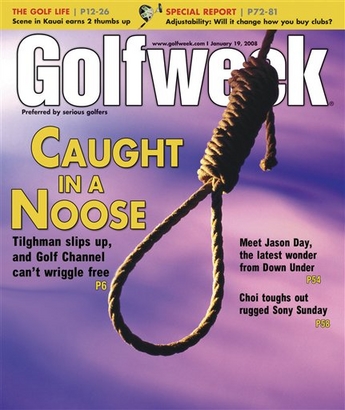
and I didn't say 1958!