I had never imagined one day I’d find myself smack in the middle of a domestic dispute with the mother of my youngest son. But here I am, with a relationship turned sour in the rear-view mirror, a precocious young boy seemingly caught in the middle. I’m searching for ways to redirect the constant exchange of insults and innuendos, the defamation being traded between us.
I have always regarded myself as a positive thinking brother; I just didn’t believe in allowing negativity – and negative people! – into my private domain. I’m still scratching my head as to how it happened.
Lately, though, my thoughts have turned outward to the hundreds of thousands, perhaps millions of black fathers across America, missing in the lives of their kids or who at one time may have been involved in promising relationships with the mothers of their children, but through some breakdown in communication, some odious inability to work things out, things, to quote the venerable Achebe, fall apart, the center cannot hold.
So now that I am a member – a card carrying member, apparently – of this club, I speak from where I am.
Brothers, there is only one person caught in the cross-fire of contempt between you and the mother of your child or children: your offspring. Isn’t it funny how two people who claim to be adults can’t call a truce in the interests of those little ones who never asked to be caught up in the riff-raff in the first place?
A part of me hurts. Or maybe all of me hurts, yet is divided into parts. One that pines for my son, his loveable ways, his adoring smile, the other that grieves the death of a relationship, the cessation of love, the end of the affair.
If I sound like I am waxing romantic here, it’s because I am. I cannot see love as anything but a tragic romance, even with its comedic tapestry. But the real tragedy is the stunted emotional crisis forced upon a young child.
Brothers, we cannot allow our crisis to become their crisis and, regrettably, so many of us have elected to fade from the scene rather than deal with the ignominious effects of lost love.
If you are a brother reading this, and love has long since died, know that there is a constant source of love in the eyes of your child or children, who yearn to connect, or reconnect, with you. If that doesn’t happen, a part of you will always be dead, a part of you will haunt that child and that, in spite of your wishes to inflict as much emotional pain onto the mother, will be the greater calamity of their lives – long after you leave the scene.
Fortunately I have today, while there is still a specter of hope and while I can still see clearly the ramifications of my actions. I will not allow my grievances with an individual who co-created my son, to shatter my future as a good father, indeed, as a good man. Things may indeed fall apart, but, when we consider what’s in the balance, the center must hold. A future depends on it.

Tuesday, December 9, 2008

Friday, November 28, 2008
Guest Post: Black Men and Suicide by Joshua Alston, Newsweek Magazine
The line between public and private in the Internet age became blurrier last week following the case of Abraham Biggs, the 19-year-old Floridian who committed suicide by overdosing on prescription medication as a populated chat room watched him via his live webcam. The voyeuristic nature of Biggs's death is disturbing, but it draws attention to the equally disturbing rate of suicide among young black men. According to the American Association of Suicidology, the rate of suicide among black men ages 15-24 increased 83 percent in the '80s to early '90s. While the rate has fallen since, suicide is still the third leading cause of death among young black men, who are seven times as likely to commit suicide as black women. Dr. Sean Joe is an Assistant Professor of Social Work at the University of Michigan who studies suicide and other self-destructive behaviors among young black men. He spoke to NEWSWEEK's Joshua Alston. Excerpts:
NEWSWEEK: What was your initial impression of the Biggs case?
Sean Joe: My first reaction is, obviously, one of sadness. It's a sad situation. But there was also, for me and for many, surprise that this was an African-American male. Also there's the issue of the content provider, their efforts to control or block access to the content, and the shocking nature of the voyeurism involved.
Why were you surprised that he was African-American?
As someone who studies this area, I wasn't surprised in that black men engage in suicidal behavior. I was surprised, though, by the nature of the suicide: both the means, the use of a substance, and the exhibitionist aspect of it. Generally speaking, firearms are most often used in suicides, followed by some type of asphyxiation, and then poisoning. But the rate at which firearms are used is higher among African-Americans. Also there is still a lot of stigma in the black community with mental-health issues and seeking help for them. Because this young man did it in this extremely public way, it's clear that he was not as affected by that stigma. That's what makes this such a unique case. Many families have trouble talking about suicide even after the fact because it's such a major source of stigma. That's not specific to blacks, obviously, but it is very common among black families.
Is there a perception in the black community that suicide is not a problem?
There was an idea in the black community, and to a certain degree in the mental-health community, that blacks didn't engage in suicidal behavior. But there was a large increase in suicides among African-Americans, particularly young black males that began in the late 1980s and rose to its peak in the late 1990s. The current rate of suicide among black males ages 15 to 24 is not higher than that of whites, but it is parallel with it. There are still things we don't yet understand, but there is an increased understanding that, yes, young black males do engage both in suicide and suicidal behaviors that don't lead to death. And in order to help those young men, it's important to understand that they are at risk as well.
Was the increase only among young black men or were there increases in young black women too?
Actually, if we were to look at the most recent data, some of it suggests some decreases in the rates of suicide among black males and an increase in that of black females. But that data doesn't represent a dramatic shift because when you talk about black females and suicide, you're talking less than two cases per 100,000. So any slight increase in the numbers looks like a large jump in the data. Suicide among blacks is still primarily a young and male phenomenon.
In a recent interview, Dr. Alvin Poussaint said that it's possible that the rates of black male suicides could be underestimated because of so-called "victim-precipitated homicide" incidents, wherein someone engages in behavior that will likely get them killed, like provoking a police officer. Do you agree with that?
I would caution any jump to conclusions with situations such as those because it is very difficult to prove the person's intent, particularly in the suicide-by-cop cases, when someone engages with police in a way that causes the police to fire on them. It's hard to figure out in that case whether or not the person meant to die that way. But there could be an underestimation of behaviors among young black men, or men in general, in which they understand that death could be a likely result of that behavior and engage in them anyway. To knowingly engage in behavior that in all likelihood will result in mortal harm, that could be considered suicidal. But I'd caution against suggesting that the data on black male suicide is inaccurate because of those cases, particularly the suicide-by-cop cases, which don't happen very often.
Are black men less likely to seek treatment for mental-health issues?
Yes, for a variety of reasons, including their attitudes toward health-care providers and attitudes toward the efficacy of those services. The bigger challenge is redrawing black masculinity in general, and the ways in which men perceive what it means to seek help for mental-health issues. The degree to which we can reduce the stigma around seeking help, and get men to understand that it isn't weak to seek help for your issues will greatly affect our ability to reach that community.
NEWSWEEK: What was your initial impression of the Biggs case?
Sean Joe: My first reaction is, obviously, one of sadness. It's a sad situation. But there was also, for me and for many, surprise that this was an African-American male. Also there's the issue of the content provider, their efforts to control or block access to the content, and the shocking nature of the voyeurism involved.
Why were you surprised that he was African-American?
As someone who studies this area, I wasn't surprised in that black men engage in suicidal behavior. I was surprised, though, by the nature of the suicide: both the means, the use of a substance, and the exhibitionist aspect of it. Generally speaking, firearms are most often used in suicides, followed by some type of asphyxiation, and then poisoning. But the rate at which firearms are used is higher among African-Americans. Also there is still a lot of stigma in the black community with mental-health issues and seeking help for them. Because this young man did it in this extremely public way, it's clear that he was not as affected by that stigma. That's what makes this such a unique case. Many families have trouble talking about suicide even after the fact because it's such a major source of stigma. That's not specific to blacks, obviously, but it is very common among black families.
Is there a perception in the black community that suicide is not a problem?
There was an idea in the black community, and to a certain degree in the mental-health community, that blacks didn't engage in suicidal behavior. But there was a large increase in suicides among African-Americans, particularly young black males that began in the late 1980s and rose to its peak in the late 1990s. The current rate of suicide among black males ages 15 to 24 is not higher than that of whites, but it is parallel with it. There are still things we don't yet understand, but there is an increased understanding that, yes, young black males do engage both in suicide and suicidal behaviors that don't lead to death. And in order to help those young men, it's important to understand that they are at risk as well.
Was the increase only among young black men or were there increases in young black women too?
Actually, if we were to look at the most recent data, some of it suggests some decreases in the rates of suicide among black males and an increase in that of black females. But that data doesn't represent a dramatic shift because when you talk about black females and suicide, you're talking less than two cases per 100,000. So any slight increase in the numbers looks like a large jump in the data. Suicide among blacks is still primarily a young and male phenomenon.
In a recent interview, Dr. Alvin Poussaint said that it's possible that the rates of black male suicides could be underestimated because of so-called "victim-precipitated homicide" incidents, wherein someone engages in behavior that will likely get them killed, like provoking a police officer. Do you agree with that?
I would caution any jump to conclusions with situations such as those because it is very difficult to prove the person's intent, particularly in the suicide-by-cop cases, when someone engages with police in a way that causes the police to fire on them. It's hard to figure out in that case whether or not the person meant to die that way. But there could be an underestimation of behaviors among young black men, or men in general, in which they understand that death could be a likely result of that behavior and engage in them anyway. To knowingly engage in behavior that in all likelihood will result in mortal harm, that could be considered suicidal. But I'd caution against suggesting that the data on black male suicide is inaccurate because of those cases, particularly the suicide-by-cop cases, which don't happen very often.
Are black men less likely to seek treatment for mental-health issues?
Yes, for a variety of reasons, including their attitudes toward health-care providers and attitudes toward the efficacy of those services. The bigger challenge is redrawing black masculinity in general, and the ways in which men perceive what it means to seek help for mental-health issues. The degree to which we can reduce the stigma around seeking help, and get men to understand that it isn't weak to seek help for your issues will greatly affect our ability to reach that community.
Sunday, November 16, 2008
What an Obama Presidency May Portend
Now that the coronation of Barack Obama is reaching full speed and the political honeymoon is preparing to launch, it may be helpful to gather around the crystal ball and try to figure what may happen during his tour of duty. To begin with, let’s not assume the fact of Obama’s skin color will remain insignificant. Although Mr. Obama won the election with a cross-section of white and Hispanic support, there are still large quarters of the majority uncomfortable with a black man in charge (after all, Obama’s 6% margin of victory falls remarkably short of decisive). What we may have to prepare ourselves for:
Assassination attempts
There have already been foiled plots on Mr. Obama’s life, the most recent shortly before the election. According to an Associated Press report, since the November 4 election, law enforcement officials have seen more potentially threatening writings, Internet postings and other activity directed at Obama than has been seen with any past president-elect. That he is a target because he is black has always been a source of anxiety for African Americans since the primaries, and will most certainly be for his entire presidency.
A precipitous rise in hate crimes
Although federal law officials announced recently that hate crimes overall had dipped 1% last year, expect to see a spike in the number of cases for 2009. An unsettling example was cited in the above-mentioned Associated Press report regarding a Web site that got more than 2,000 new members the day after the election, compared with 91 members on Election Day. There was also a reported spike in gun sales after the election.
Messianic and resistant attitudes
The fact that we have finally elected a black man as president seems so surreal and it will take time for that to wear off. In the meantime, there will be those on both sides of the racial divide who will expect Barack Obama to take the lead in reversing decades-old negative trends in the black community (for example the high-school drop-out rate or black male incarceration) and those (mostly the opposition) who will resist such efforts. These attitudes will persist because many people expect a president to endorse policies designed to help not hinder people while others expect a person to pull themselves up by their own “bootstraps”. Understand: black America will become better by the mere presence of a black man occupying the White House; young blacks will look to this event as a catalyst to improving their lives.
Ghettoization of the presidency
This began long before Mr. Obama was elected; comedians, pundits, radio talk-show hosts and common people (not to mention some politicians) used snide, condescending stereotypes to imagine the White House as a haven for black antics, minstrelsy and uncouth behavior (hence people will cite favorites as watermelon, pool hall etc.).
Assassination attempts
There have already been foiled plots on Mr. Obama’s life, the most recent shortly before the election. According to an Associated Press report, since the November 4 election, law enforcement officials have seen more potentially threatening writings, Internet postings and other activity directed at Obama than has been seen with any past president-elect. That he is a target because he is black has always been a source of anxiety for African Americans since the primaries, and will most certainly be for his entire presidency.
A precipitous rise in hate crimes
Although federal law officials announced recently that hate crimes overall had dipped 1% last year, expect to see a spike in the number of cases for 2009. An unsettling example was cited in the above-mentioned Associated Press report regarding a Web site that got more than 2,000 new members the day after the election, compared with 91 members on Election Day. There was also a reported spike in gun sales after the election.
Messianic and resistant attitudes
The fact that we have finally elected a black man as president seems so surreal and it will take time for that to wear off. In the meantime, there will be those on both sides of the racial divide who will expect Barack Obama to take the lead in reversing decades-old negative trends in the black community (for example the high-school drop-out rate or black male incarceration) and those (mostly the opposition) who will resist such efforts. These attitudes will persist because many people expect a president to endorse policies designed to help not hinder people while others expect a person to pull themselves up by their own “bootstraps”. Understand: black America will become better by the mere presence of a black man occupying the White House; young blacks will look to this event as a catalyst to improving their lives.
Ghettoization of the presidency
This began long before Mr. Obama was elected; comedians, pundits, radio talk-show hosts and common people (not to mention some politicians) used snide, condescending stereotypes to imagine the White House as a haven for black antics, minstrelsy and uncouth behavior (hence people will cite favorites as watermelon, pool hall etc.).
Saturday, November 1, 2008
Some Thoughts on my Interview with Rev. James David Manning
When did it become fashionable to equate black pride with black self-destruction? What is the difference between black on black crime and defaming one’s family? These were just a couple of imponderables going through my head as I interviewed Rev. James David Manning on Friday, October 31. Rev. Manning, by the way, is the Harlem preacher whose videotaped sermon circulating the web includes some rather harsh language regarding Senator Barack Obama. (To view the video: http://www.youtube.com/watch?v=U4-TZspqlOs) Other thoughts:
• There has never been, and I doubt there will ever be, universal black support for a black candidate in the American political system. For reference, go back to Booker T. Washington, who advocated self-help as the panacea to black America’s ills at the time. Who was his rival? Dr. W.E.B. Dubois, who promoted change within the system as a means to achieving black empowerment; both of these men had huge followings. In more contemporary times, neither the Revs. Jesse Jackson or Al Sharpton could claim universal black support. American politics just does not allow for such a phenomenon. Now comes Senator Barack Obama, who has not fashioned his credentials primarily for black support (remember the Iowa caucus?), whose appeal cuts across a wide swath of Americans and Rev. Manning, when asked if Barack Obama is not the right leader, than who is, referenced Dr. Martin Luther King, Jr. Even Dr. King had his share of black detractors!
• Rev. Manning’s stand on black on black crime is admirable but no new position. What strikes me is his utter disregard for other forms of “black on black crime” – such as his incendiary videotaped remarks about Senator Obama’s mother. After all, is it not the case that a crime usually is preceded by thought, calibrated into words and introduced as an action?
• Does anybody really take this Bill Clinton as our nation’s first black president stuff seriously? I always thought it was merely a way of expressing kudos to Clinton’s affectionate relationship with black people.
• Like most black people, I grew up in the black church and was nurtured by the black religious experience. To suggest that Black people need to return to God is a bit pie-in-the-skyish; black people need to use the power that God gives us! Reminds me of a book that I need to add to my library: If God is So Good, Why Are Black People Doing So Bad?
• There has never been, and I doubt there will ever be, universal black support for a black candidate in the American political system. For reference, go back to Booker T. Washington, who advocated self-help as the panacea to black America’s ills at the time. Who was his rival? Dr. W.E.B. Dubois, who promoted change within the system as a means to achieving black empowerment; both of these men had huge followings. In more contemporary times, neither the Revs. Jesse Jackson or Al Sharpton could claim universal black support. American politics just does not allow for such a phenomenon. Now comes Senator Barack Obama, who has not fashioned his credentials primarily for black support (remember the Iowa caucus?), whose appeal cuts across a wide swath of Americans and Rev. Manning, when asked if Barack Obama is not the right leader, than who is, referenced Dr. Martin Luther King, Jr. Even Dr. King had his share of black detractors!
• Rev. Manning’s stand on black on black crime is admirable but no new position. What strikes me is his utter disregard for other forms of “black on black crime” – such as his incendiary videotaped remarks about Senator Obama’s mother. After all, is it not the case that a crime usually is preceded by thought, calibrated into words and introduced as an action?
• Does anybody really take this Bill Clinton as our nation’s first black president stuff seriously? I always thought it was merely a way of expressing kudos to Clinton’s affectionate relationship with black people.
• Like most black people, I grew up in the black church and was nurtured by the black religious experience. To suggest that Black people need to return to God is a bit pie-in-the-skyish; black people need to use the power that God gives us! Reminds me of a book that I need to add to my library: If God is So Good, Why Are Black People Doing So Bad?
Sunday, October 26, 2008
Barack Obama: The Ultimate Role Model
I don’t tend to agree with everything that former NBA player Charles Barkley says, but he had it right several years ago when he emphatically declared: “I am not a role model!” Leaving aside the implied wish not to be looked up to by millions of young black kids across America, his words still ring true. Our black youth tend to look to sports, cinema and music as paradigms for material success in a culture that supposedly rewards hard work and ambition. These genres, however, only reinforce the “American Idol” effect on society, promising instant success with little sweat.
With the ascendancy of Barack Obama, things may change. Now black parents, mentors, guardians, and extended family members have an authentic, reliable and incontrovertible role model to point to when extolling the virtues of hard work, determination and education – things black folk have always tried to instill in their children. The reason Obama overshadows other black politicians or statesmen as a viable role model is that he has transcended race in a way others – with the exception of Colin Powell – could not. Sports stars are looked up to for excellence in their respective sport, as are actors, rappers and pop stars in their genres. They’re personal failings – and this is why Barkley’s declaration is important – are magnified and, in many cases, vilified. There is, in effect, a ceiling they cannot exceed. Obama, on the contrary, and in spite of personal failings, has the type of capital that can be exploited by black parents – regardless of their political philosophy – that reinforce that jagged yet noble trajectory from obscurity to success.
You don’t have to be a protector of democratic values to recognize the importance of witnessing an African American male on the cusp of the world’s most powerful office. The slaves would never have imagined it, but we should feel fortunate to witness in our lifetime the ultimate role model.
With the ascendancy of Barack Obama, things may change. Now black parents, mentors, guardians, and extended family members have an authentic, reliable and incontrovertible role model to point to when extolling the virtues of hard work, determination and education – things black folk have always tried to instill in their children. The reason Obama overshadows other black politicians or statesmen as a viable role model is that he has transcended race in a way others – with the exception of Colin Powell – could not. Sports stars are looked up to for excellence in their respective sport, as are actors, rappers and pop stars in their genres. They’re personal failings – and this is why Barkley’s declaration is important – are magnified and, in many cases, vilified. There is, in effect, a ceiling they cannot exceed. Obama, on the contrary, and in spite of personal failings, has the type of capital that can be exploited by black parents – regardless of their political philosophy – that reinforce that jagged yet noble trajectory from obscurity to success.
You don’t have to be a protector of democratic values to recognize the importance of witnessing an African American male on the cusp of the world’s most powerful office. The slaves would never have imagined it, but we should feel fortunate to witness in our lifetime the ultimate role model.
Subscribe to:
Posts (Atom)


About the Editor

- W. Eric Croomes
- Arlington, Texas, United States
- W. Eric Croomes is a writer and playwright based in Irving, Texas and a native of Phoenix, Arizona. Eric is a graduate of Jarvis Christian College in Hawkins, Texas, earning a Bachelor of Arts in religion and sociology and is founder and executive director of Millennium Men of Color, a non-profit black male advocacy group. In 2002, Eric self-published Dance in the Dark, Poetic Reflections on Love and Culture, a collection of his original poems and essays on love and relationship in the African-American tradition. Three to Eight, a play examining the hours when most teens become pregnant and most juvenile crime is committed, was Eric’s first theatrical release and debuted at the 2004 Black N Blues one act play festival at the African-American museum in Dallas. Brotha2Brotha, Becoming Healthy Men from the Inside Out, a spiritual primer for men of color, was released in September, 2006. Eric’s next book, Thoughts in Black and Male, is slated for release in spring 2008. COMING SOON: THEVILLAGEREPORT.NET Visit Eric at www.wericcroomes.com
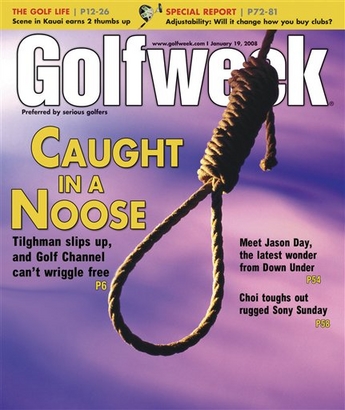
January 19, 2008 issue of Golfweek Magazine
and I didn't say 1958!