

Thursday, September 13, 2012

Thursday, September 6, 2012
For Brothas Only: Can We Really Handle Independent Black Women?
We’ve all heard of her; she’s been crooned, immortalized and hyped since the beginning of the 1990’s as the strong, self-sufficient black woman. She’s appeared in film, literature and theater as the saving grace of the black family and the antidote to black male patriarchy. In the process, she’s become the star of African American post-modern folklore; there aren’t too many black families that don’t claim her as one of their own. She is the independent black woman, and when it comes to black men, there are no shades of grey – you either love her or you don’t!
So why are independent sistas feeling a lil hate on the part of black men in an era where we’ve supposedly advanced far enough in gender relations to respect the progress of black women? Can black men really handle this new breed of sisterhood?
The attitudes of black men regarding strong, successful black women seem to run the whole gamut – from a grudging acceptance to applause to outright rejection. Such attitudes persist even in the face of statistics that show a widening gap between how black women and men are faring in the American economy and otherwise: more black women than men hold degrees; the unemployment rate for brothers is twice that of white men; and, in a recent poll conducted by Millennium Men of Color, only 18% of black male respondents described relationships between the black sexes as “good”.
How do black men deal with a woman who’s been raised to make it without him and how do black women – the ones who really want to love and be loved – reach out to men who feel this way?
Unfortunately, the line of demarcation is usually marked by economics. It is not sobering that black men and women tend to measure one another by economic means, as opposed to spiritual standards or by more common themes such as family values, work ethic and religious commitment.
There are plenty of brothers who honor and respect a woman who is at the top financially, professionally and spiritually. Sadly, though, there are far too many brothers who struggle with this reality. It’s mainly because of how we have been socialized to see ourselves as providers. We’ve been stripped of that role in a sense, not because women insist on being breadwinners, but because, in most cases, they didn’t have a choice! Unfortunately, brothers have occupied the bottom rung of the economic ladder when it comes to jobs. We tend to be the first fired and the last hired; overall, American employers shy away from hiring black men.
As a result of this role reversal, too many brothers either suffer in silence or exhibit hostility toward their more successful counterparts. Let’s face it brothers, our psyche has taken a beating due to this peculiar American experience. And so our reactions have more to do not with how much our women make, but rather how much we aren’t making in comparison. As a result, we focus on what we don’t want – to be judged by our wallets alone and whether we are financial equals. We then miss out on what we really want: a loving relationship in which our masculine identities and contributions are valued – what we bring to the table overall.
Add to this the I-don’t-need-a-man revolt that began in the 1990’s and many brothers are feeling the blues when it comes to relationships with successful women.
What we need, brothers, is a new way of thinking. We should attempt to understand that black women, successful or not, are also entangled in a system that has yet to afford them full acceptance in the marketplace. Not only that, we must accept that – regardless of how we’ve been socialized – times have changed.
Let’s not be locked into dictates just because it’s the way we were raised. Are you really going to toss and turn tonight because a woman offered to pay for dinner? Are you less a man because she makes more money than you? My answer: absolutely not!
Independent black women are here to stay! And, with the emergence in the last four years of Michelle Obama as the quintessential successful black woman, independent sisters are and will be a force for some time.
Finally, we need as black men to realize that – politics aside – our women do indeed need us, just like we need them. There are very few black women who do not need – as Stephanie Williams once crooned – ‘the comfort of a man’. Beneath the thin veneer of financial success, professional acclaim and spiritual bliss is an insatiable need to love and be loved by a man (emphasis on man) who will come correctly.
Take heart brothers! For every Michelle, there is a Barack! We can relate to our successful sistas and give them their just desserts. In doing, so we become models for a generation of men.


Friday, May 18, 2012

Friday, May 11, 2012

Monday, April 9, 2012
Bill Cosby Blames Gun Accessibility For Death Of Trayvon Martin, NJ Mural Causes Controversy
Famed comedian Bill Cosby weighed in on the death of 17-year-old Trayvon Martin, and he put the blame squarely on the easy accessibility of guns: “We’ve got to get the gun out of the hands of people who are supposed to be on neighborhood watch,” Cosby told the Washington Post. “Without a gun, I don’t see Mr. Zimmerman approaching Trayvon by himself. The power-of-the-gun mentality had him unafraid to confront someone. Even police call for backup in similar situations. When you carry a gun, you mean to harm somebody, kill somebody."
Protesters are gearing up for the announcement whether the U.S. Justice Department will prosecute shooter and former neighborhood watch captain George Zimmerman for the Feb. 28 shooting—the decision whether Angela Corey, the special prosecutor appointed by Governor Rick Scott, will bring this matter before the grand jury is expected to come on April 10. Martin supporters are using social media to encourage people to wear a hoodie on April 10 as a sign of solidarity.
Some already have been: current and former college students from Florida State University, University of Florida, Tallahassee Community College and FAMU, calling themselves the "Dream Defenders," have marched 40 miles over the last three days to protest the death: "This is the catalyst to give young people the motivation to act," said Stephen Green, a sophomore at Morehouse College in Atlanta. "We are the ones with the energy to keep this going."
Closer to home, there was a Harlem Hoodie March this week, featuring students from the Democracy Prep Charter High School. "Because of the way you dress, some police officers think you are a hoodlum," junior Christopher Franco told DNAInfo. "They think you are the next drug dealer. Trayvon Martin is in the same position we are. It could have been any one of us."
Inspired by these protests, Baltimore preacher Rev. Jamal Bryant spearheaded a mass voter-registration drive coinciding with packed crowds for Easter Sunday: 50,000 black congregations nationwide hope to register 1 million voters today. "You can't just show up and shout and make noise. You have to do it with the vote," said Rev. Willie Barnes, pastor of Macedonia Baptist. "You can't change the system until you change the people who are running it."
Things aren't so unified everywhere: a new street mural in Elmwood Park, NJ, has caused much controversy. Lawrence Langerlaan, 71, is one of the people who object to the mural that features a faceless black man wearing a hoodie, with the message "We Got You Trayvon." "Had the hooded character not been there, and the kid's name up, I might not have objected," Langerlaan told WPIX. "It kind of makes us feel like drugs, gangs and that kind of thing. This is a nice quiet neighborhood."
"We didn't draw his head being blown off. We didn't put bullet holes on the wall. We didn't depict gun violence. And there's certainly no gang affiliation here," responded Carmelo Sigona, one of the five artists responsible for it. Building owner John Quinn supports the piece though: "I want them to use this as a canvas to bring other issues to the public."
Contact the author of this article or email tips@gothamist.com with further questions, comments or tips.
Tuesday, April 3, 2012
Trayvon's 'Stand Your Ground' Rights

Trayvon was also allowed to defend himself. But the state has rarely protected African-Americans' right to do so
BY DELORES JONES-BROWN, THE CRIME REPORT
I am both a former prosecutor and the mother of a 15-year-old son. When my son was little, like most moms, I told him to beware of strangers; that even in a nice neighborhood, like ours, a pedophile might drive through looking for a child victim. I told him to watch out for strangers, even in nice neighborhoods, because once he was inside the trunk of a car, I might not be able to help him.
Trayvon Martin was 17 years old and, based on the photos, not very big — like my son.
Based on media accounts and the reports of the 911 calls, he was walking through a nice, but unfamiliar neighborhood, talking on his cellphone when a strange adult male began to follow him in a SUV. At one point, he thought he had lost him, but the male reappeared following him again. This time the man, who was nearly twice his size (in body mass), got out of the vehicle, approached him, and had a gun.
Under Florida’s “stand your ground” law, Trayvon was allowed to stand his ground and use force to defend himself. If the gun was visible as George Zimmerman approached him, Trayvon would have been allowed to use deadly force against Zimmerman.
Previous cases in Florida have upheld subjective, though mistaken, beliefs about the danger presented to the person who feels threatened. Under the law, as the aggressor in this situation, Zimmerman had no right of self-defense.
Why was Zimmerman the aggressor?
1) The police dispatcher had advised him not to follow or approach Trayvon Martin.
2) On the 911 call, Zimmerman initially said that he was concerned about break-ins in the area. Deadly force is not legally authorized to protect property.
3) Zimmerman said that he thought the “suspect” might be high or using drugs. Both are offenses that do not warrant the use of deadly force in apprehension efforts.
4) Zimmerman also said, “Those assholes always get away …,” which clearly indicates that he had decided that Trayvon was guilty of something — he was no longer merely a “suspect.” So his approach, whether with his gun in hand or concealed, was with the intent to confront a “criminal.” Such an approach would be aggressive rather than passive.
To Trayvon, Zimmerman was a stranger. The media has made much of the fact that there are no other witnesses to what happened except George Zimmerman and Trayvon Martin. That would mean that this child was being approached on an isolated street by a strange adult, with a gun, driving a big vehicle.
Zimmerman is a threat, and Trayvon is in the fight of his young life — perhaps in the belief that he is fighting for his life.
Ironically, I have not yet seen this version of the Trayvon Martin case portrayed in the media. Standard media analysis of this incident begins with Zimmerman’s claim of self-defense and the applicability of the “stand your ground” law to Zimmerman. Did Trayvon have no right to be afraid of this strange, large man, with a gun, who had been following him for some time, in a vehicle large enough to abduct him?
A Department of Justice report from 2002 notes that in one year nearly 800,000 children under age 18 are reported missing, nearly 60,000 of them are reported as abducted by a stranger. Was this high school football player required to stand idly by to wait to see what this aggressive stranger planned to do to him?
Or, did the statute allow him to defend himself, as the Sanford Police Department was satisfied that Zimmerman had a right to do?
A Republican sponsor of the “stand your ground” law has indicated in media accounts that, based on the information currently available about the incident, he does not believe that the “stand your ground” law applies to Zimmerman. It seems that no one has yet asked whether the law would have applied for the protection of Trayvon Martin.
That was a colorblind analysis of the incident for those who choose to believe that race had nothing to do with this encounter.
Now for some ugly race facts.
For nearly two and a half centuries the right of self-defense did not apply to African-Americans against attackers under the laws of many states and, after emancipation a noted writer named Hinton Rowan Helper referred to African-Americans as “Negroes … with their crime-stained Blackness,” when discussing why blacks should not be allowed to vote and why racial segregation was paramount in social relations.
In 2004, Stanford University professor Jennifer Eberhardt and her colleagues wrote an article titled “Seeing Black: Race, Crime and Visual Processing,” in which she presents the results of several recent psychological studies that found race effects exist in all of our daily thinking and especially with regard to the association between blackness, crime and perceptions of danger.
So in the end, this encounter isn’t really about the hoodie; any racial proxy will do.
This historical and scientific background begs the question: If the racial roles were reversed in the Trayvon Martin killing, would the criminal justice system response be the same?
One might look to the 2006 Long Island, N.Y., case involving John Harris White for a possible answer. In that case, an African-American father shoots a white teenager who is in his driveway. The white teenager, Daniel Cicciaro, age 17, had come to John White’s home with a group of other white teenagers to attack John White’s 19-year-old son after an altercation that had taken place at a different location.
Although John White claimed that he had acted in self-defense when he pointed a gun at Cicciaro and, that the gun had accidentally discharged when Cicciaro tried to grab it, John White was arrested, tried and convicted of manslaughter and was sentenced to two to four years in prison. John White served five months in prison before his sentence was commuted by Gov. Patterson.
In that incident, John White’s family was under attack at their own home. The “castle doctrine” on which the “stand your ground” law is based, provides the greatest protection for persons who are threatened at their homes, but John White was arrested, tried, convicted and sentenced to prison.
George Zimmerman is free, and a blanket of racially tinged controversy hovers over private and media discussions of whether George Zimmerman deserves to be punished and, in some circles, whether Trayvon Martin deserved to die.
Close
Delores Jones-Brown is a professor in the Department of Law, Police Science and Criminal Justice Administration at the John Jay College of Criminal Justice in New York, and former director of the John Jay Center on Race, Crime and Justice. More Delores Jones-Brown
Friday, March 23, 2012
Trayvon Martin and the Burden of Our Black Boys

Join me Sunday, March 25, 2012 for: The Burden of Our Black Boys.
In the wake of Trayvon Martin's senseless killing, how do we protect our black boys from a society that despises them? Plus, will there be justice for Trayvon? We'll ask a panel of mentors and social justice advocates!
Next TVR! Dial 347.215.9517 at 5pm central to listen or comment.
Raising awareness. Inspiring change.
Wednesday, February 29, 2012
It's Just Good Living!
As a trainer I always observe who's in the gym, particularly those I haven't seen in a while. This morning I saw a friend who'd been out at least a year. I didn't have a chance to speak with her but later sent her a text as to how good it was to see her back in the gym. My heart shuddered when she replied: "It's good to be back..I'm still mourning the loss of my son." Turns out her son was killed about a year ago. I encouraged her to remain strong and continue to remain active while grieving. But she was at the end of her rope, despite a strong support system: "...sometimes i really just want to give up. It's too painful." I immediately stopped texting her and called. I'm sharing my experience to accentuate the fact that we never know what a person is going through, what pain they are feeling and how they are handling it. Sometimes a friendly 'hello, friend I haven't seen you in a while' makes all the difference in the world for a person struggling with grief (or any issue). As a person who lost both parents in a span of two years, i can attest to that. Next time you see an old friend, speak, give em a hug! It's just good living!
Wednesday, February 22, 2012
Relationships: The Good, The Bad, The Ugly!

We've all been in bad relationships and even some good ones! Was Whitney Houston's troubled relationship with Bobby Brown one of the reasons for her decline? What's a good, bad and ugly relationship? Which category does your relationship fall under? Join me this Sunday, February 26, 2012 at 5pm central for a provocative and enlightening edition of TVR! My special guest will be Dr. D. Ivan Young, Relationship Expert. He'll take your calls live this Sunday on TVR!
The Village Report. Raising Awareness. Inspiring change.
To call in to the show, dial 347.215.9517 from a landline or mobile phone. Press 1 on your device if you'd like to ask a question or make a comment. See you on air!
Friday, February 17, 2012
Next TVR: Is Black Support for the Prez Declining?
Date change!!

Are we taking his re-election for granted? Is there a sense of urgency in the black community ensure four more years? Join me Sunday, March 11, 2012 at 5pm central for an enlightening discussion on President Obama's chances of being re-elected.
The Village Report. Raising awareness. Inspiring change.
Saturday, February 11, 2012
TVR is back online! Sunday, Feb. 12: Cheaters!

My show, "The Village Report with W. Eric Croomes: Cheaters" on "The Village Report" is airing 02/12/2012 on BlogTalkRadio. See the details and set a reminder at http://tobtr.com/s/2847957. RSVP to my facebook event:
Wednesday, November 30, 2011
A W. Eric Croomes Comment: The Nexus of Parenting, Relationship and Youth in the Black Community
In the past three weeks our Dallas/Fort Worth community has been rocked by a trilogy of murder, deviant parenting and the loss of a promising young life.
First we watched in agony as a young mother egged her middle-school age daughter into fisticuffs with another young lady; we reacted in horror at the news that a nineteen-year old young man had been pushed to his death in front of a train because he refused to give up his Ipod; and we were shocked at yet another incident of domestic violence when a young man, apparently distraught regarding the end of his relationship, gunned down his children’s mother, her stepfather and her younger sister’s boyfriend.
It is tempting to wag our heads in disbelief and dismiss the above incidents as common occurrence. Then we don’t have to accept our responsibility.
We must, however, view what happened with a different set of cultural lens. Then we’d see the nexus of parenting, relationships and the perplexing issues touching our youth. We’d see the three incidents not as isolated events, but rather as a continuum of the decline in values that has rocked our country and, by default, our community.
The common ingredient in all three scenarios is violence. We live in a violent culture; our relationships are touched with conflict. The messages we get on an almost daily basis is use force to get what you want. Hence, a mother teaches her young daughter to use her fists; a group of young men use group intimidation; a man employs a bullet.
What’s happened to us? How did we fall so low? And, most crucially, who is responsible?
It’s easy to point out fingers in all three incidents. But here’s the greater point: in a very real sense, all of us – by default – is responsible. We all share in the plot and execution of every conceivable incident of crime in our community when precious lives are taken and even more precious lives are left in tatters.
I am responsible when I don’t use my God-given voice to speak to a person reeking with self-destructive behaviors. Each of the offending parties comes from a family unit. Somebody had to catch wind of a young mother’s angry spirit; somebody had to witness the slow descent of one of those young men into the abyss of negative peer pressure; surely someone had to glimpse the despair of a young man who didn’t quite know how to handle the end of a relationship. And maybe someone did try to intervene at some point, at some time. But was it enough? Could more have been done?
But maybe it’s you reading this piece that may need the most attention. I have been for the last year embroiled in a bitter child visitation and access war with the mother of my youngest son. Words have been exchanged; no doubt insults hurled. But at the forefront of my mind I keep this one positive truth: it doesn’t have to be this way. And that leads me to find other, more diplomatic routes to intervention. But we can commit to doing better, to take a more active role in the lives of those whom we know to be spiraling out of control. We may or may not change outcomes, but in the end what counts is having tried. In trying, we at least prevent the ruined lives left in the wake of tragedy.
Wednesday, June 1, 2011

No Glory Without a Story: How to Move Past the Hurt, Guilt and Mistakes of Your Past
A critically-acclaimed anthology of writers who share the power of the pen to relate how they overcame some incredible odds to claim their God-given, brand-new future! Whatever challenge you are going through, you will be inspired by these valiant men and women of God who's only reason for participating in this project is to empower the reader!
I am honored to have been asked to participate in this life-changing literary project!
No Glory Without a Story! Real stories. Real struggles. Real victories!
Empowered reading!
W. Eric Croomes
Available soon on Amazon, Barnes and Noble.com! For ordering information call 214.493.2875 or 817.504.7257
And join me for the launch of my Conversations on Being Black and Male in America book tour Saturday, June 18, 2011 from 2p to 4p at the Dock Book Store in Fort Worth, Texas 6637 Meadowbrook Driv 817.457.5700
Tuesday, May 31, 2011
W. Eric Croomes presents: No Glory Without a Story!
W. Eric Croomes Presents
Hello my friend! I am excited to announce the publication of the critically-acclaimed book, No Story Without a Story, How to Move Forward in Victory after the Hurt, Guilt and Mistakes of Your Past, to be released June 10, 2011 (M&M Consulting)! This is a book that is edited by Dr. Mia Y. Merritt and compiled by twenty authors whose sole mission is to help readers move through some of life's toughest challenges we as authors have been through!
No Glory Without a Story is an anthology of writers who intimately share how we overcame some very difficult times in our personal lives - broken relationships, parenting issues, financial challenges, depression, infidelity to name a few - how our testimony was shaped and how that testimony can help empower you!
In my chapter - Their Eyes Were Watching Daddy - I write about fatherhood: my story, my lessons and my advice to men who are seeking to remain relevant in the lives of their offspring. As the father of two sons born during two very different periods of my life, I am seeking to be the best father I can be and I want fathers who are struggling with their role to know they have a kindred soul!
No Glory Without A Story is the culmination of a dream of our editor, Dr. Mia Y. Merritt, who desired to compile a literary medium of authors who would directly share their own life stories toward the purpose of empowering those who are going through tough times. I have posted her information below to let you discover more about this incredible woman of God who is changing the world!
I am inviting you to join me on June 18, 2011 from 2pm to 4pm at the Dock Bookstore in Fort Worth, Texas, as I begin a substantive conversation regarding the general issues in No Glory Without a Story and the specific challenges of being black and male in America in relation to fatherhood, relationships and the economy. More information to follow!
No Glory Without a Story! Real stories. Real struggles. Real victories!
Empowered reading!
W. Eric Croomes, contributing author
W. Eric Croomes is an author, motivational speaker and editor of TheVillageReport.Net, a monthly blog-mag dedicated to the educational, economic, social and spiritual empowerment of the African American community. He is host of The Village Report with W. Eric Croomes, a weekly issues and answers talk-show that airs on BlogTalkRadio.com.
Eric is a graduate of Jarvis Christian College in Hawkins, Texas, and is founder and executive director of Their Eyes Were Watching Daddy, a non-profit support group for unmarried and divorced fathers.
In 2002, Eric self-published Dance in the Dark, Poetic Reflections on Love and Culture, a collection of his original poems and essays.
Brotha2Brotha, Becoming Healthy Men from the Inside Out, a spiritual primer for black men is Eric's second self-published book and was released in September, 2006.
Learn more about editor and publisher Dr. Mia Y. Merritt at:
www.miamerritt.com
Contact information for W. Eric Croomes:
W. Eric Croomes
Cell: 214.493.2875
wericcroomes@yahoo.com
Like us on Facebook at: Their Eyes Were Watching Daddy
Monday, May 30, 2011
I'm A Changed Man!
Changed men make for changed lives, changed families, changed communities. But where does that type of profound change come from? How does a man change from being negative to positive, from being weak and docile to strong and courageous, from engaging in self-destructive behavior to harnessing his authentic power as a valiant man of God?
As we witness St. Paul on a dusty Damascus road, we see that true and lasting change comes as a result of a direct confrontation with God; it is, therefore, profoundly spiritual. What we need, then, are men who have been changed spiritually, for spiritual formation is the foundation to an empowered life, as evidenced by a transformation of his intent and perspective.
The Acts record Saul, before his transformation to Paul, as suffering from evil intent, as he sought to “ravage the church.” His intent was wrong-headed, malicious and mean-spirited; he only wanted to see the church suffer. Saul sought the persecution of the early church. But look what happens; Saul runs into God on a bustling road to Damascus through a blinding light, which knocks him off his horse. God, though, does not touch Saul’s intentions, but works on his perspective, instructing Saul to “get up, and enter the city.” Paul ultimately becomes the trailblazer of the early church and history’s most revered son of faith.
Who really can recite the chorus, “I’m a changed man”!? It is the man who, simply, was doing something that was destructive and is now engaging in things that are constructive. If you’ve been abusing substances and you say I’m a changed man, but you are still abusing substances, it would be quite hard to believe you. When a man has truly been changed, his intent and his perspective change, as well.
For, the single lesson we can extract from Paul's unique visitation with God on the Damascus road is that sometimes God does not necessarily change our direction, but rather changes our perspective on the direction we're headed. Saul is instructed to go into the city – the same city where he intended on pillaging the church – but now his perspective is different, he now has a new mission! This change of perspective can only come by spiritual transformation. By spiritual I mean the inward dimension of life that flows from direct communion with God, a communion nurtured by prayer, ritual, meditation and worship. “Life is first an inner experience”, writes author Susan L. Taylor, “all the peace and security we are seeking is within us.”
"I'm a changed man" is a chorus, ringing with jubilance, yet the verses are made up of self-examination, vigorous reflection and the courage to move on in spite of our fear. You see, change may inspire fear in you; it may cause you to walk tepidly among the carnage of your insecurities. A lot of people have experienced failure because they could not handle change.
Changed men are powerful men; changed men are courageous, changed men are leaders. They can move mountains, they can launch global movements, and they can take a stand for righteousness. Changed men are what we need.
Wednesday, January 21, 2009
TVR Editorial: Where Do We Go From Here?
On Tuesday, January 20, 2009 Barack Hussein Obama, the nation’s first African American president, called the nation to “a new era of responsibility.” It is a noble call to all Americans to help make our country better. Yet it is a call that resonates in the black community like a trumpet. For, now that the pageantry has ended, the revelry has tempered, and the shadow of something the slaves could only dream about has begun to recede, the question is now, where do we go from here? Did we travel to the nation’s capital merely to catch a glimpse of history? Or do we use this majestic occasion to look within ourselves and our communities and find new ways to heed this era of new responsibility? The hard work now begins.
Yet we know for certain that it cannot begin with our fooling ourselves, as may portend a recent CNN poll which found that sixty nine percent of blacks surveyed agreed that the dream of equality has been fulfilled. The presence of a black man as leader of the free world 146 years after the Emancipation Proclamation and 45 years after Dr. King’s dream is no fair arbiter of equality, only a sign that, indeed, progress has been made. And now the dream is put on par with responsibility (indeed Dr. King preached responsibility no less fervently).
Where does this responsibility begin? I say it begins with the person in the mirror. We must recommit ourselves to hard work, hard choices and hard love; finding within ourselves intestinal fortitude to improve our own lives. Each of us has a purpose we’ve been created to strive toward, a greatness – not just fame – that beckons the best within us.
We must, as well, find it within ourselves to take a stand against that which has undermined our self-love and self-esteem for so long now. We must demand of men, myself included, a commitment to the welfare of our families; we must take a stand against the tyranny of ignorance that divides our communities – from the misogynistic lyrics of pop stars to the lunacy of “bagging” among our young black men.
When we muster the best of ourselves and our community, when we become concerned about the issues that beset us, our acceptance of this “era of responsibility” has truly begun.
Thursday, December 11, 2008
The Myth of the Independent Black Woman

We’ve all heard of her; she’s been crooned, immortalized and hyped since the beginning of the 1990’s as the strong, self-sufficient black woman. She’s appeared in film, literature and theater as the saving grace of the black family and the antidote to black male patriarchy. In the process, she’s become the star of African American post-modern folklore; there aren’t too many black families that don’t claim her as one of their own. She is the independent black woman.
But are independent black women really that independent? And, with all due respect to the crooner Neo, how did the independent black woman come about in the first place, if, in fact, we even give preeminence to her existence?
The Disappearing Black Male
To best answer this we’d have to turn to history and look at such factors as the disappearance of black men as viable marriage partners for black women. If black women have theoretically become independent, it stands to reason at some point they were dependent or, at the very least, co-dependent with men. So what happened?
There are several factors, but let’s start with this one: economics and labor (read: jobs). It’s no coincidence that the emergence into popular culture in the 1990’s of the I-don’t-need-a-man movement coincided with the Clinton inspired economic boom, when it was widely reported that black people were faring as well economically as anytime in American history. It’s befitting, then, that we begin our discussion with the economics behind the façade of independence. Today, the unemployment rate for black males is 9.5%, twice the national average for all males across all ethnicities. This upward trend has had a slow, steady march for the past fifty years and is intimately connected to the closing of steel mills, manufacturing and auto plants and other staples of American productivity. The result: black men began to disappear from the labor force.
At about the same time, two other peculiar events began to unfold. As families began to feel the impact of less black males in the workforce, black mothers began to whisper into the precocious ears of black girls: “get you an education and do things for yourself! Don’t wait on no man to do it for you!” Don’t get me wrong; black mothers were not being hateful toward black males (at least, I’m sure, in most cases); on the contrary, they were looking out for the best interests of their daughters. The other significant event was the election of Ronald Reagan as president of the United States and the advent of the war on drugs and the so-called law and order society.
These three historical events – the reduction of black men in the labor market, how little black girls were socialized, and the law and order society (in terms of how it was a precursor to black male incarceration rates) have all conspired to produce a vacuum in the number of black marriageable men and has, in my opinion, contributed to the myth of the independent black woman.
The Real Meaning of Independence
Now, what’s my point? The point is black women today who pride themselves on being independent should realize their status was attained not just through hard work, determination and burning the midnight oil, but also through a confluence of economic, political and cultural events that aided and abetted their success.
I say this because today the term “independent” seems to have been applied to sisters as a badge of self-reliance, a carefully crafted image pushed to extremes, whose only goal is to reinforce a false notion that they are “self-made”, propagating a kind of economic relativism.
As a result, the black marriage market has been thrown into chaos and relationships between the sexes are as strained as ever. Sadly, a lot of brothers regard independent sisters as so way out, so deeply entrenched in fantasy, that they lose even the desire to approach them (usually interpreted as an inability to handle a “strong black woman”). Is this really the point of achieving independence, to be so insulated from reality that even the prospects of living the rest of one’s life alone raises no internal concern?
Besides this, the notion of independence is neither biblically nor culturally meaningful. If most of black life and love is predicated on our religious experience (as most of it is), and if most black women extract a fair amount of comfort from that experience (and they do), then how do we reconcile notions of independence and what it means to be committed to the well-being of the entire village, if not the opposite sex? What about the emotional, spiritual and non-physical intimate needs that was given to a woman by the Creator and was designed to be fulfilled by a man (although we are responsible for its nurturing)? We were not created in a vacuum; didn't God create a man for a woman and a woman for a man?
Black Relationships: A New Paradigm
What we need are strong, positive, mutually beneficial relationships. We should nurture, love and respect one another’s opinions and ideas and together achieve a sense of becoming while working toward a common goal.
For an embodiment of those ideals, we can turn to our first African American president, Barack Obama, and his wife, Michelle. They have both been successful in achieving the American dream. Although I am not privy to the details of their personal interactions, I must only assume that their success story has had, like all relationships, its share of lows, as well as highs. In the end, however, they were able to forge a mutually benefiting union, one that superseded power relations.
But here is the greater point: Obviously Michelle Obama could have built her own castles of success, given her stellar educational accomplishments. But she chose to leave her career and work tirelessly on the career of her husband. Now I am not suggesting that every woman should follow suit; contrary, what I am saying though is that the sister didn’t have a problem with it.
Instead of lauding Michelle Obama as the model of black feminine independence (as a lot of black women are doing), let’s salute her for channeling that independent energy toward pushing her husband upward to the pinnacle of American politics. Because in the end, Michelle needed Barack and Barack needed Michelle! Michelle Obama didn’t subscribe to the lunatic theory that she didn’t need a man!
Black males want to provide for their families, just like males of any other ethnicity. But how to do it in the face of declining wages, a huge gap in earnings compared to white males and the aforementioned historically high unemployment rate is the challenge for black men today. We’ve got to fight back against that by getting more black males into college and/or pursuing a trade or craft that can be used for economic mobility; in short, education is paramount!
These are the challenges we face, but we really face them as a unit. Black women still experience sexism, racism and other forms of exploitation; the wages they earn still lag woefully behind those of white women. The truth is we are all trying to make it happen! In historical terms, our situation is not much different than that of black men and women who came up from slavery.
They faced a hostile society, open hostility, below minimum wage standards, the prospect of a future with no economic fortune at their fingertips (unlike what we have today): can you imagine the likelihood of an independent black woman back then?
Tuesday, December 9, 2008
Things Fall Apart
I had never imagined one day I’d find myself smack in the middle of a domestic dispute with the mother of my youngest son. But here I am, with a relationship turned sour in the rear-view mirror, a precocious young boy seemingly caught in the middle. I’m searching for ways to redirect the constant exchange of insults and innuendos, the defamation being traded between us.
I have always regarded myself as a positive thinking brother; I just didn’t believe in allowing negativity – and negative people! – into my private domain. I’m still scratching my head as to how it happened.
Lately, though, my thoughts have turned outward to the hundreds of thousands, perhaps millions of black fathers across America, missing in the lives of their kids or who at one time may have been involved in promising relationships with the mothers of their children, but through some breakdown in communication, some odious inability to work things out, things, to quote the venerable Achebe, fall apart, the center cannot hold.
So now that I am a member – a card carrying member, apparently – of this club, I speak from where I am.
Brothers, there is only one person caught in the cross-fire of contempt between you and the mother of your child or children: your offspring. Isn’t it funny how two people who claim to be adults can’t call a truce in the interests of those little ones who never asked to be caught up in the riff-raff in the first place?
A part of me hurts. Or maybe all of me hurts, yet is divided into parts. One that pines for my son, his loveable ways, his adoring smile, the other that grieves the death of a relationship, the cessation of love, the end of the affair.
If I sound like I am waxing romantic here, it’s because I am. I cannot see love as anything but a tragic romance, even with its comedic tapestry. But the real tragedy is the stunted emotional crisis forced upon a young child.
Brothers, we cannot allow our crisis to become their crisis and, regrettably, so many of us have elected to fade from the scene rather than deal with the ignominious effects of lost love.
If you are a brother reading this, and love has long since died, know that there is a constant source of love in the eyes of your child or children, who yearn to connect, or reconnect, with you. If that doesn’t happen, a part of you will always be dead, a part of you will haunt that child and that, in spite of your wishes to inflict as much emotional pain onto the mother, will be the greater calamity of their lives – long after you leave the scene.
Fortunately I have today, while there is still a specter of hope and while I can still see clearly the ramifications of my actions. I will not allow my grievances with an individual who co-created my son, to shatter my future as a good father, indeed, as a good man. Things may indeed fall apart, but, when we consider what’s in the balance, the center must hold. A future depends on it.
Friday, November 28, 2008
Guest Post: Black Men and Suicide by Joshua Alston, Newsweek Magazine
The line between public and private in the Internet age became blurrier last week following the case of Abraham Biggs, the 19-year-old Floridian who committed suicide by overdosing on prescription medication as a populated chat room watched him via his live webcam. The voyeuristic nature of Biggs's death is disturbing, but it draws attention to the equally disturbing rate of suicide among young black men. According to the American Association of Suicidology, the rate of suicide among black men ages 15-24 increased 83 percent in the '80s to early '90s. While the rate has fallen since, suicide is still the third leading cause of death among young black men, who are seven times as likely to commit suicide as black women. Dr. Sean Joe is an Assistant Professor of Social Work at the University of Michigan who studies suicide and other self-destructive behaviors among young black men. He spoke to NEWSWEEK's Joshua Alston. Excerpts:
NEWSWEEK: What was your initial impression of the Biggs case?
Sean Joe: My first reaction is, obviously, one of sadness. It's a sad situation. But there was also, for me and for many, surprise that this was an African-American male. Also there's the issue of the content provider, their efforts to control or block access to the content, and the shocking nature of the voyeurism involved.
Why were you surprised that he was African-American?
As someone who studies this area, I wasn't surprised in that black men engage in suicidal behavior. I was surprised, though, by the nature of the suicide: both the means, the use of a substance, and the exhibitionist aspect of it. Generally speaking, firearms are most often used in suicides, followed by some type of asphyxiation, and then poisoning. But the rate at which firearms are used is higher among African-Americans. Also there is still a lot of stigma in the black community with mental-health issues and seeking help for them. Because this young man did it in this extremely public way, it's clear that he was not as affected by that stigma. That's what makes this such a unique case. Many families have trouble talking about suicide even after the fact because it's such a major source of stigma. That's not specific to blacks, obviously, but it is very common among black families.
Is there a perception in the black community that suicide is not a problem?
There was an idea in the black community, and to a certain degree in the mental-health community, that blacks didn't engage in suicidal behavior. But there was a large increase in suicides among African-Americans, particularly young black males that began in the late 1980s and rose to its peak in the late 1990s. The current rate of suicide among black males ages 15 to 24 is not higher than that of whites, but it is parallel with it. There are still things we don't yet understand, but there is an increased understanding that, yes, young black males do engage both in suicide and suicidal behaviors that don't lead to death. And in order to help those young men, it's important to understand that they are at risk as well.
Was the increase only among young black men or were there increases in young black women too?
Actually, if we were to look at the most recent data, some of it suggests some decreases in the rates of suicide among black males and an increase in that of black females. But that data doesn't represent a dramatic shift because when you talk about black females and suicide, you're talking less than two cases per 100,000. So any slight increase in the numbers looks like a large jump in the data. Suicide among blacks is still primarily a young and male phenomenon.
In a recent interview, Dr. Alvin Poussaint said that it's possible that the rates of black male suicides could be underestimated because of so-called "victim-precipitated homicide" incidents, wherein someone engages in behavior that will likely get them killed, like provoking a police officer. Do you agree with that?
I would caution any jump to conclusions with situations such as those because it is very difficult to prove the person's intent, particularly in the suicide-by-cop cases, when someone engages with police in a way that causes the police to fire on them. It's hard to figure out in that case whether or not the person meant to die that way. But there could be an underestimation of behaviors among young black men, or men in general, in which they understand that death could be a likely result of that behavior and engage in them anyway. To knowingly engage in behavior that in all likelihood will result in mortal harm, that could be considered suicidal. But I'd caution against suggesting that the data on black male suicide is inaccurate because of those cases, particularly the suicide-by-cop cases, which don't happen very often.
Are black men less likely to seek treatment for mental-health issues?
Yes, for a variety of reasons, including their attitudes toward health-care providers and attitudes toward the efficacy of those services. The bigger challenge is redrawing black masculinity in general, and the ways in which men perceive what it means to seek help for mental-health issues. The degree to which we can reduce the stigma around seeking help, and get men to understand that it isn't weak to seek help for your issues will greatly affect our ability to reach that community.
Sunday, November 16, 2008
What an Obama Presidency May Portend
Now that the coronation of Barack Obama is reaching full speed and the political honeymoon is preparing to launch, it may be helpful to gather around the crystal ball and try to figure what may happen during his tour of duty. To begin with, let’s not assume the fact of Obama’s skin color will remain insignificant. Although Mr. Obama won the election with a cross-section of white and Hispanic support, there are still large quarters of the majority uncomfortable with a black man in charge (after all, Obama’s 6% margin of victory falls remarkably short of decisive). What we may have to prepare ourselves for:
Assassination attempts
There have already been foiled plots on Mr. Obama’s life, the most recent shortly before the election. According to an Associated Press report, since the November 4 election, law enforcement officials have seen more potentially threatening writings, Internet postings and other activity directed at Obama than has been seen with any past president-elect. That he is a target because he is black has always been a source of anxiety for African Americans since the primaries, and will most certainly be for his entire presidency.
A precipitous rise in hate crimes
Although federal law officials announced recently that hate crimes overall had dipped 1% last year, expect to see a spike in the number of cases for 2009. An unsettling example was cited in the above-mentioned Associated Press report regarding a Web site that got more than 2,000 new members the day after the election, compared with 91 members on Election Day. There was also a reported spike in gun sales after the election.
Messianic and resistant attitudes
The fact that we have finally elected a black man as president seems so surreal and it will take time for that to wear off. In the meantime, there will be those on both sides of the racial divide who will expect Barack Obama to take the lead in reversing decades-old negative trends in the black community (for example the high-school drop-out rate or black male incarceration) and those (mostly the opposition) who will resist such efforts. These attitudes will persist because many people expect a president to endorse policies designed to help not hinder people while others expect a person to pull themselves up by their own “bootstraps”. Understand: black America will become better by the mere presence of a black man occupying the White House; young blacks will look to this event as a catalyst to improving their lives.
Ghettoization of the presidency
This began long before Mr. Obama was elected; comedians, pundits, radio talk-show hosts and common people (not to mention some politicians) used snide, condescending stereotypes to imagine the White House as a haven for black antics, minstrelsy and uncouth behavior (hence people will cite favorites as watermelon, pool hall etc.).
Subscribe to:
Posts (Atom)


About the Editor

- W. Eric Croomes
- Arlington, Texas, United States
- W. Eric Croomes is a writer and playwright based in Irving, Texas and a native of Phoenix, Arizona. Eric is a graduate of Jarvis Christian College in Hawkins, Texas, earning a Bachelor of Arts in religion and sociology and is founder and executive director of Millennium Men of Color, a non-profit black male advocacy group. In 2002, Eric self-published Dance in the Dark, Poetic Reflections on Love and Culture, a collection of his original poems and essays on love and relationship in the African-American tradition. Three to Eight, a play examining the hours when most teens become pregnant and most juvenile crime is committed, was Eric’s first theatrical release and debuted at the 2004 Black N Blues one act play festival at the African-American museum in Dallas. Brotha2Brotha, Becoming Healthy Men from the Inside Out, a spiritual primer for men of color, was released in September, 2006. Eric’s next book, Thoughts in Black and Male, is slated for release in spring 2008. COMING SOON: THEVILLAGEREPORT.NET Visit Eric at www.wericcroomes.com
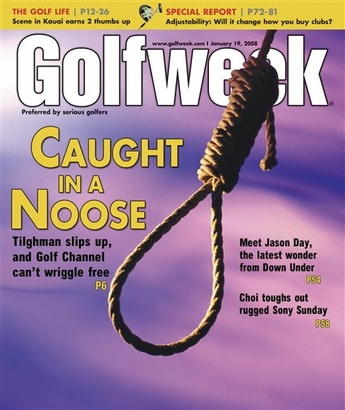
January 19, 2008 issue of Golfweek Magazine
and I didn't say 1958!